
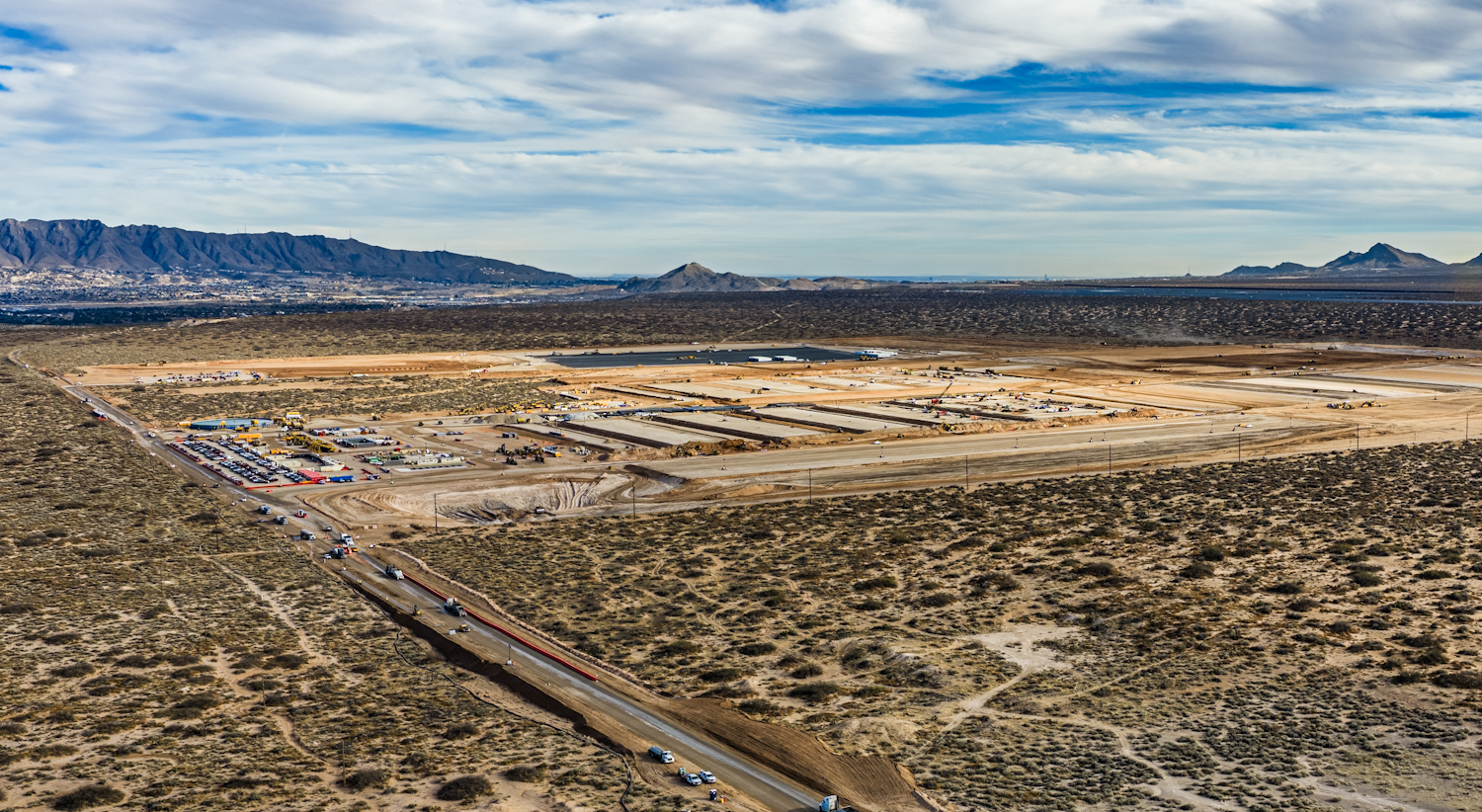
If you have driven down near the Santa Teresa port of entry lately, you have probably seen a lot of truck traffic near the turnoff for the Columbus highway (NM-9). A half-mile back or so, the earth is being reshaped into a data center for Project Jupiter.
It’s a familiar sight in the Southwest, where the desert is often treated as a blank canvas for whoever has the biggest checkbook. Right now, Project Jupiter is in that awkward teenage phase of construction. There are no gleaming server halls yet, just massive foundations being poured and parking lots being carved out of the scrub. You can see the water tanks standing like sentinels against the horizon crowded around a big reservoir, a reminder that even the most advanced artificial intelligence in the world still gets thirsty, even in its infancy.
I recently stood out there with Annie Ersinghaus (watch our live interview here), an activist who has been sounding the alarm on what this $165 billion project actually means for us. We looked at those water tanks and talked about the sheer scale of the thing. She pointed out that while the developers talk about a closed-loop system, the initial fill-up alone is going to swallow 10 million gallons of water. When you realize this project could eventually emit more greenhouse gases than the two largest cities in New Mexico combined, the pragmatic part of my brain starts to itch. We are being told this is the future, but it looks a lot like the same old industrial story we have seen for a century.
On the other hand, there are reasons to think that it might be different this time. The possibilities that this kind of automation can unlock could, over time, outweigh the shorter term environmental impacts. It’s the old “they could have cured cancer if they’d have lived” argument, but with a robot this time. Do we strangle the robo-infant in the cradle because it keeps soiling its diapers when it might find a cure for all dirty diapers in the future?
It is not just Santa Teresa that faces this dilemma. Just across the Franklin Mountains in Northeast El Paso, Meta is clearing land for a massive 1 gigawatt campus. This site sits right up against Chaparral, a community that has spent decades fighting with El Paso over resources and the environment while El Paso accuses people who move to Chaparral of being property tax freeloaders. It is a strange irony that a community still struggling with reliable access to clean water is now watching a multi-billion dollar machine move in next door when it’s unclear who will bear the burdens and who will reap the benefits.
We are seeing this pattern repeat in Tucson and Chandler, where local councils have started to push back against these “Project Blues” and speculative server farms. In Marana, the planning commission recently voted to move forward with a 600-acre site, but they did it to a chorus of shouts of “shame” from the gallery.
A Better Way To Look At This
We’ve been trained from a young age, often by Disney films, to look for the good guys and the bad guys in stories like this. But, reality is almost never that simple. Instead, I like to take the approach that futurists often use, and look at three possible futures: a great one, a terrible one, and one that’s in the middle.
The first is the one the brochures sell us, the great “solarpunk” future. In this version, the high-carbon natural gas plants they are building today are just a bridge. As the initial frenzy to train these massive AI models settles down and renewable energy capacity explodes, these sites actually start to clean up. The desert becomes a hub of clean power that feeds a new way of living.
We see a decentralized Southwest where well-off people (and that’s basically everyone via things like UBI, sovereign wealth funds, etc) move into satellite communities, no longer tethered to a commute because the AI handles the heavy lifting of the economy. In this world, sovereign wealth funds or some form of universal basic income allow people to live in the beauty of the desert without exploiting it. It is a world where the machine serves the landscape, not the other way around.
The second story is the middle of the road, and honestly, it is the one I think is most likely. It is the story of the struggle. In this future, the first few datacenters like Jupiter and the Meta site struggle to get off carbon power because the grid just cannot move fast enough. We deal with the “warts and all” of the transition, including some ugly air quality days and ongoing disputes over water rights. But there is a silver lining here. These machines enable the very breakthroughs in battery chemistry and grid management that help the rest of the world transition to clean energy. We find a way to navigate the shift from a labor-based economy to an automated one without falling into mass poverty. It is not perfect, and there are plenty of infrastructure headaches to report on, but we muddle through. We figure it out, one permit and one solar farm at a time.
For the people involved, a similar story of mixed struggle and success plays out. Some people benefit, but others are displaced. Limited programs exist to cover for the lack of jobs, leaving some people constantly short of what’s needed to be comfortable, but not left in utter destitution and homelessness. Over time, we figure out that the old ways can’t serve us, and we have to find new ways to pay people that aren’t tied to labor.
Then there is the third story, the one that keeps me up at night. This is the path where high pollution leads to even more high pollution. The Southwest becomes a machine hellscape, a place where the primary export is compute power and the primary import is environmental degradation.
The promised jobs do not materialize because the machines are self-sufficient, and the local economy collapses as automation wipes out traditional roles. We start to see “Altmanvilles” appearing on the horizon, named after the visionaries who promised us a utopia but delivered a displacement. These are the modern-day Hoovervilles, nomadic populations of the displaced living in the shadows of the very server farms that replaced them. The Bureau of Land Management struggles to deal with the social fallout, and even the smallest desert towns find themselves overwhelmed by homelessness and poverty because there is simply no one left to hire a human being while we all choke on high ozone and dust storms.
The Future Hasn’t Been Written Yet
Standing there in the desert near Santa Teresa, it was hard to tell which of these futures is being poured into those foundations. The developers at Project Jupiter have been less than transparent, often skipping public hearings or splitting their permits to avoid the strictest environmental monitoring. It is the same lack of transparency that led Tucson to kill its own massive data center project last year. People are tired of being told to just “trust the process” when the process involves their air and their water.
I want to be optimistic, though. Anyone who has really spent time experimenting with AI and really seeing what it can do sees the possibilities. The chatbots we talk to now do make some really bone-headed mistakes and even “hallucinate”, but at the same time, what they get right was unimaginable to most just a decade ago. If we get this right, we may be unlocking a lot of future prosperity not only for the billionaires backing it, but for the rest of us, too.
Ultimately, it’s up to us what happens. That’s both frightening and something to be optimistic about.
No matter what happens, my plan is to be here for all of it. Whether we are heading toward a solarpunk paradise or the outskirts of an Altmanville, I will be watching the horizon. I will be flying around these sites along with many others that are likely coming. The desert wasn’t a great place to build cities in the 19th century and a good chunk of the 20th, but in the 21st century, we are likely to see a “machine landscape” pop up, for better or worse.
I hope you will stick around to see how it unfolds so we can all get a bird’s eye view.
Leave a Reply